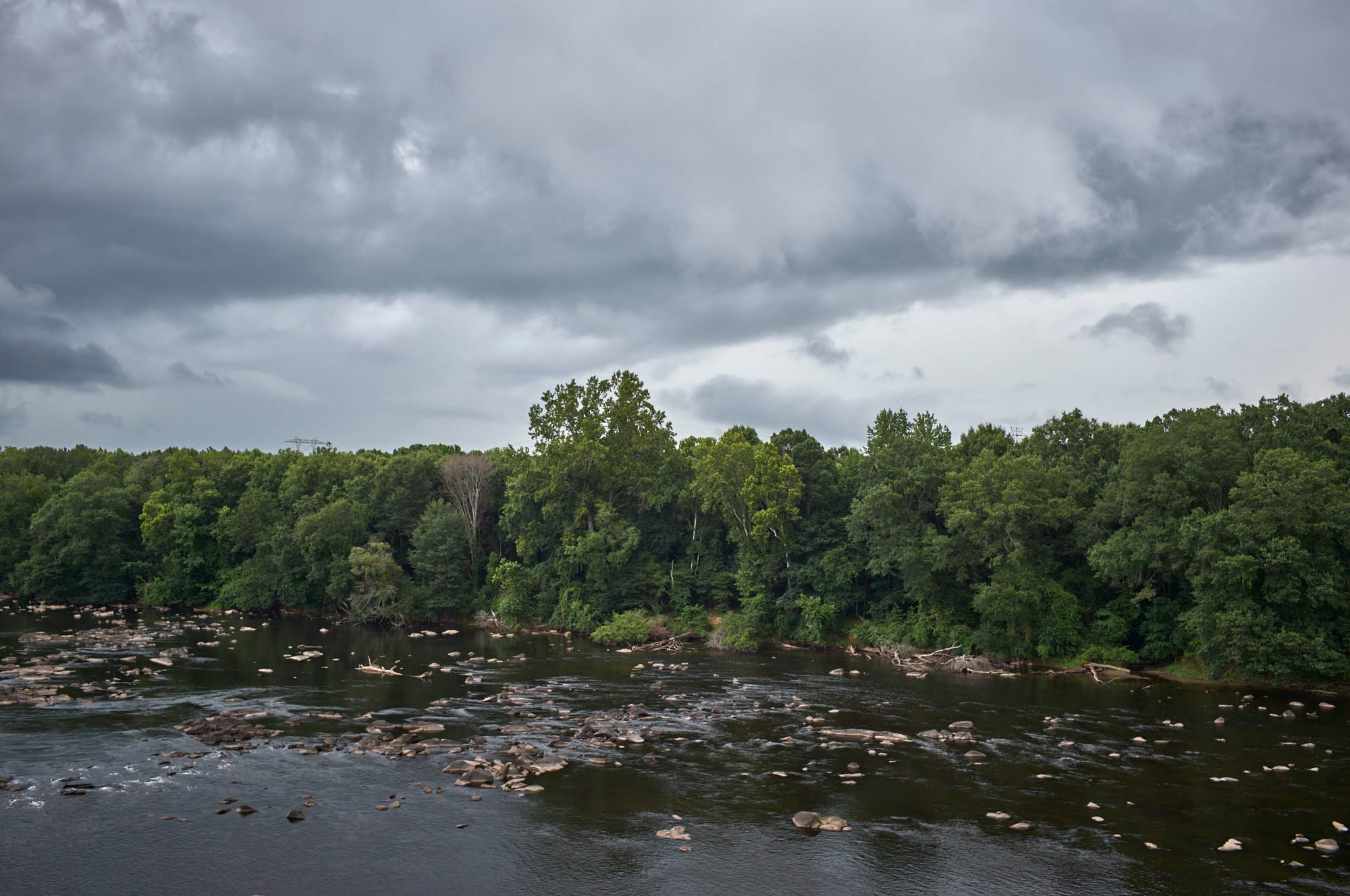
It hadn’t rained in some time, and things were getting dry. Yet, when I was leaving work this afternoon, the sky was cloudy, dark, and moving. It wasn’t that swirly moving, like a tornado was coming. We don’t often get those in the Southeast. No, it was more like an athlete running down the track. The clouds were low, like you wanted to reach out and touch them, low. Growing up in the mountains, I learned long ago that when the wind blew and the tree’s leaves turned over in the wind, rain was 10 to 20 minutes away. I looked at my watch.
The beauty of cloudy days, especially these kinds, is that clouds make for great photographs. An otherwise ordinary scene that looks like a postcard with a blue sky behind it becomes much more unique with rumbling, thunderstorm clouds. Of course, that meant I pulled out my EV1.
I shot a lot of film growing up and in college. I still shoot a lot of film, especially black and white film. Turning on the EV1, I had to wait for everything to boot up. It doesn’t take but a moment, and truth be told, it doesn’t seem any different from any of the other Leica M digital cameras I’ve used over the years. But it isn’t film. I cannot pull out the camera, bring it up to my eye, and just press the shutter. I guess that’s why I still shoot film and why film cameras last so long. By long, I mean that I still shoot with a 1964 Leica M3. Yet, I digress.
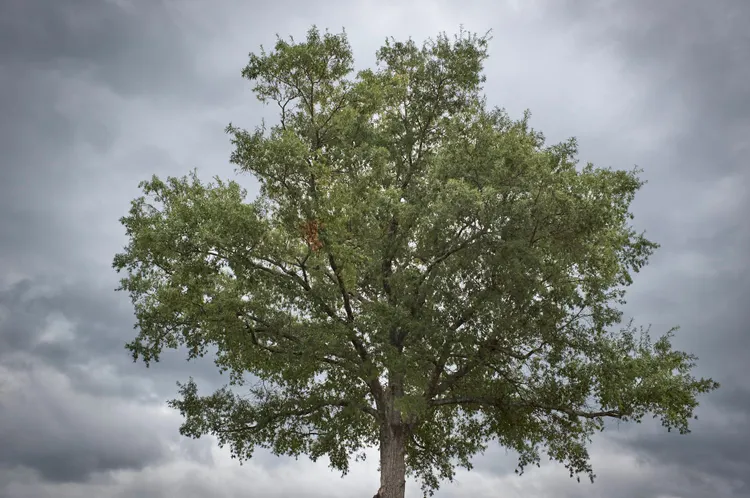
There is a tree outside my office in the parking lot that I love to photograph over and over. It is a simple oak tree with a rounded crown, but nothing is in the background. There are no tall buildings, and I’m close enough to photograph just the crown. So, I looked through the EVF as my right hand began to turn the shutter speed dial. It was dark enough that the tree was fairly dark and the sky had bright patches from the clouds and dark, dark patches underneath. Not a hint of blue sky was around.
Since I had the metering on highlight mode, I knew the photograph might be a little dark. I had a Summicron-M 35mm ASPH version 1 attached. It’s the black-chrome brass version, which I enjoy because of the heft in my hands and because, photographing on the coast, brass always weathers better than aluminum in the salty air. In any event, this lens does really well at f/4 and f/5.6, the sweet spots, so to say. That's why I leave the lens on f/4 in my bag.
I’ve shot the SL system since the release of the type 601 in 2015, and I still have the 24-90 and 90-280 zooms I got then. I’m no stranger to EVFs, and I understand some of the limitations, although the current EVFs are pretty nice (the SL3 and Q3 and EV1). Gone are much of the shimmering, the sloppy lag, and high-contrast views. Instead, I get to see close to what I’ll see on the back of the camera when I chimp the shutter press afterward. Today, things looked dark in the viewfinder. I looked out at the tree. They were dark. So, I pressed the shutter.
Hmmm, I thought afterward. That looks pretty bright. The tree was greener and had more color to it than I saw in the viewfinder, and the clouds were rather light. Not very ominous. I looked up at the sky again. Not long before it would rain and pretty hard by the look of things. I reset the user preferences to my first saved spot, the one I worked on the other day, as I fumbled through the settings one-by-one. I looked through the viewfinder again. Nice and dark. Click. Too bright.
It was then that I realized that I had played with the brightness setting in the EVF. I don’t normally change the brightness, even on the SL system. I checked the setting, and it was at -2, so pretty low! After moving it back to zero, things looked much more like the results I had. Now, I could reduce the exposure time and capture the feeling of the impending storm I started with. Much better, I thought as I smiled at the chimped image on the back of the camera. Dumb mistake, was my next thought. Lesson learned.
So here’s today’s tip. There are more ideas I have from today, but I’m going to explore them before I put them down here.
Think about some of the lessons you've learned in your photography. Consider writing them down and happy shooting!!